
The Trillion-Dollar Autocomplete
Last week, the company behind Claude rang the opening bell at the Nasdaq and pulled off the largest IPO in history. Millions of people now use Claude every day, yet very few could explain what it actually is. So with Thanksgiving slowing everyone down, we're doing something a little different. In today's read, we cover the IPO, then take a guided tour of what a large language model really is, from the 1950s to the Google paper that changed everything, and why understanding it will make you sharper at your job.
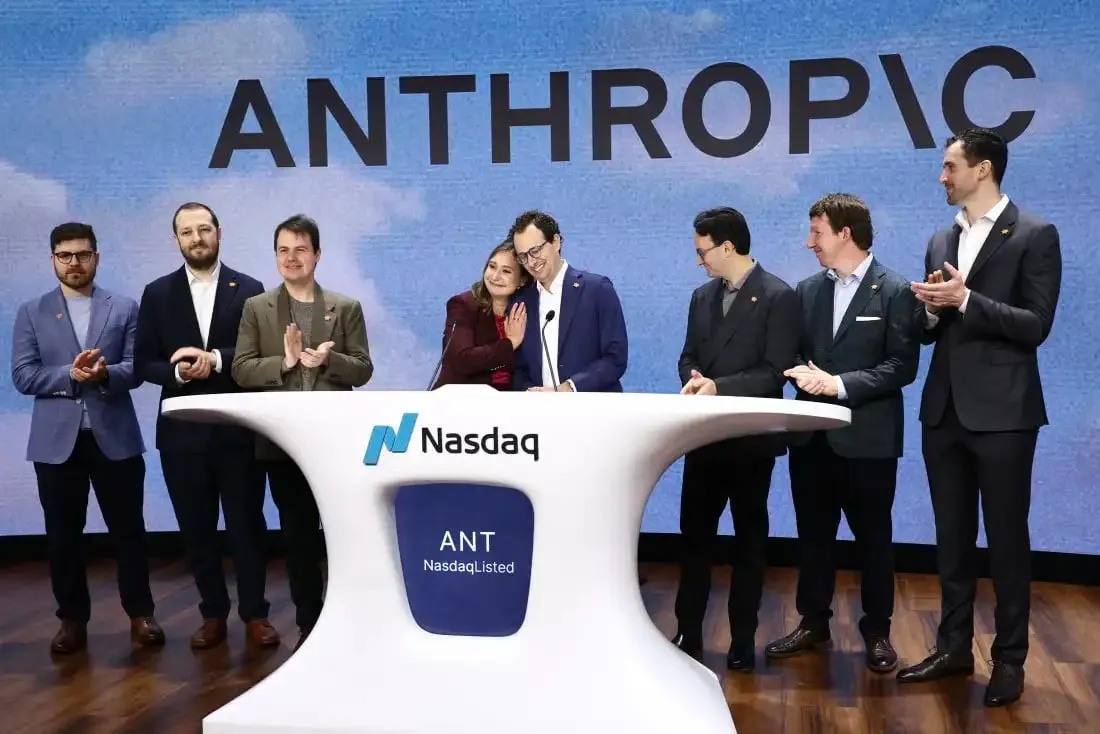
The Biggest IPO Ever, With A Bumpy Landing
Anthropic raised a record $93.5 billion when it priced its shares at $83 last Wednesday, topping the $75 billion SpaceX raised in June. The stock popped to $111.50 at Thursday's open, then gave back much of that gain to close Friday at $88.91, in the middle of tech's worst week on Wall Street since 2020.
The bumpy ride doesn't change the bigger story. Anthropic's revenue went from $386 million in 2024 to $33.2 billion in just the first nine months of 2026, according to its filings. No company this large has ever grown this fast. And as a public company, everything it does in Washington now comes with a much brighter spotlight.
So What Is Claude, Actually?
Claude, whose newest flagship model, Fable 5.2, launched earlier this month, is a large language model, or LLM. You've probably used it, or its cousins ChatGPT and Gemini, this week. But if a relative asks over turkey what it actually is, "a chatbot" isn't really an answer. Here's the real one.
Seventy Years Of Teaching Machines To Think
The term "artificial intelligence" dates to a 1956 summer workshop at Dartmouth. For decades, researchers tried to build intelligence by hand, writing out rules like "if the patient has a fever and a rash, consider measles." These rule-based "expert systems" worked in narrow cases and broke the moment the world got messy. Funding dried up more than once, in stretches researchers still call "AI winters."
What eventually won was a different idea: instead of writing the rules, let the machine learn them from examples. That's machine learning, and the tool that made it work is the neural network.
Neural Networks: Learning Like A Toddler
A neural network is a web of digital connections loosely inspired by the brain, and the easiest way to understand it is to think about how a child learns to talk. No toddler learns English from a grammar book. They hear millions of sentences, take guesses, get corrected, and slowly develop an instinct for what sounds right. Nobody hands them the rules. The rules emerge from the practice.
An LLM learns the same way, just at a scale no child could ever match. It reads trillions of words, constantly guessing what comes next. Every connection inside the network carries a number, called a weight, that decides how much one piece of information influences the next. Each wrong guess nudges those weights slightly toward the right answer. Repeat that across trillions of examples and the network develops something like instinct: patterns of grammar, facts, and reasoning that no human ever wrote down. The biggest models today reportedly have more than a trillion of these weights.
Tokens: The Lego Bricks Of Language
Computers don't read words. They read numbers. So before Claude sees your sentence, it chops the text into tokens, small chunks that are usually a word, part of a word, or a punctuation mark. Take a sentence from this newsletter:
"Anthropic just pulled off the largest IPO in history."
A typical tokenizer might break it into eleven tokens:
[Anthrop] [ic] [ just] [ pulled] [ off] [ the] [ largest] [ IPO] [ in] [ history] [.]
Common words get their own token, and rarer words like "Anthropic" get split into pieces. Then the math begins: each token is swapped for an ID number from the model's vocabulary, and each ID for a long list of numbers, called an embedding, that captures its meaning (the numbers here are illustrative):
[ IPO] → ID 3,425 → [0.21, −0.87, 0.04, 1.12, …]
Words with similar meanings, like "senator" and "legislator," end up with similar lists. Our sentence is now just a grid of numbers, and everything that happens next is math. A rough rule of thumb: 100 tokens is about 75 English words, which is why AI companies price per token, the way a utility prices by the kilowatt-hour.
The 2017 Paper That Changed Everything
Before 2017, language models read text like you'd read through a straw: one word at a time, left to right, often losing the beginning of a long sentence by the time they reached the end. Then eight Google researchers published a paper with a cheeky title, "Attention Is All You Need." It introduced the transformer, the "T" in ChatGPT and the architecture underneath Claude, Gemini, and nearly every major model today.
The breakthrough was a mechanism called attention. Instead of reading in a line, a transformer looks at every token in a passage at once and calculates how much each one should pay attention to every other one. Consider: "The senator tabled the bill because it lacked the votes." You instantly know "it" means the bill, not the senator. Attention is how the model figures that out, by scoring the relationship between "it" and every other word and finding that "bill" and "votes" matter most. Stack dozens of these layers on top of each other and the model starts tracking grammar, context, tone, and meaning across entire documents.
It's All Math, And Nvidia Sells The Calculators
There is no encyclopedia inside Claude. Every response is one enormous math problem. Your prompt's grid of numbers gets multiplied through billions of weights to predict the next token. The model adds that token to the text and runs the whole calculation again, often thousands of times for a single answer.
Those millions of simultaneous multiplications are exactly what Nvidia's graphics chips were built to do for video games, which is how a company that once sold gaming cards became one of the most valuable companies on Earth.
Finishing School: Reinforcement Learning
Training happens in two big phases. First comes pretraining, where the model reads an enormous slice of the internet, books, and code, and practices a single task over and over: predict the next token. That's where it absorbs grammar, facts, and patterns of reasoning.
But a model that only predicts text is a know-it-all with no manners. Ask it a question and it might respond with three more questions. So the second phase is reinforcement learning, which works a lot like coaching a new staffer. The model produces answers, those answers get graded, and the weights shift toward whatever earned high marks. Early on, the graders were mostly humans ranking responses. Increasingly, the grading is automatic: did the code run, did the math check out, did the task actually get done? That shift is a big reason models have gotten dramatically better at coding and multistep work.
From Words To Pictures, Voices, And Video
Once researchers realized almost anything can be turned into tokens, the same recipe spread everywhere. An image gets cut into small square patches, each treated like a token. Audio gets sliced into fractions of a second. Video becomes a sequence of image patches over time. Run those tokens through a transformer and the same core machinery can describe a photo, transcribe a hearing, or generate a campaign video.
The Big Reveal: It's Autocomplete
Strip away the branding and here's what an LLM is: a staggeringly sophisticated autocomplete. It's the same basic idea as your phone suggesting the next word in a text message, scaled up by trillions of words of training and some of the largest computers ever built. It doesn't "know" things the way you do. It predicts what text should come next, and it has gotten so good at that prediction that the results look like reasoning, writing, and expertise.
LLMs aren't the only branch of AI. Robotics, self-driving cars, and scientific systems like Google DeepMind's AlphaFold, which predicts the shapes of proteins, each rely on their own approaches, and any of them could take the lead someday. For now, LLMs are the dominant force. And here's the irony: progress in those other fields is increasingly powered by LLMs themselves, which write the code, read the research, and help run the experiments. Anthropic says more than 90% of the changes merged into its own core codebase are now written by Claude.
What This Means For Public Affairs
If you remember one thing from this edition, make it the autocomplete idea, because it explains AI's most dangerous habit. LLMs hallucinate, meaning they confidently state things that aren't true, because they're built to produce the most plausible next word, not the verified one. Ask a model which committees a freshman member sits on, and it will give you an answer that sounds exactly right whether or not it is. A made-up bill number, a misattributed quote, or a stakeholder who changed jobs last year all look identical to the truth from the model's point of view. In our business, one of those mistakes in front of a client or a legislator costs more than the tool ever saved.
Enterprise AI solves this by changing the model's job. Instead of asking it to remember facts, you hand it the facts, pulled from deterministic sources like verified databases, document libraries, and knowledge graphs, and ask it to reason over only that material. The model stops being the source of truth and becomes the analyst working from a verified file. That's the approach behind Neptune's AI-I Advanced Influencer Intelligence™ and AI-G Adaptive Intelligence General™ software. These AI-native tools analyze thousands of verified data sources to determine who influences a decision-maker and how to talk to them about any issue, while using LLMs to reason through the data we hand them, instead of autocompleting on their own.
Three Ways To Operationalize This Email
🔱 Double-check the specifics. AI is generally reliable at summarizing, drafting, and reorganizing material you give it. It's least reliable when it has to pull specific facts from memory: names, titles, vote counts, bill numbers, dates, and quotes. That's where hallucinations hide, so verify every one before it goes out the door.
🔱 Feed it, don't quiz it. Paste in the bill text, hearing transcript, or stakeholder list and tell the model to work only from that material. You'll get far more reliable output than asking it to recall facts on its own.
🔱 Ask your vendors where the facts come from. Any AI tool pitching you on targeting or intelligence should be able to explain whether its answers are grounded in a verified database or graph, or generated from model memory. If they can't answer, that's your answer.
— Bryan Miller
Founder & CEO, Neptune Ops